
Sports recovery mattress topper
A sports recovery mattress topper It does not need to be plugged in, does not heat up and does not need to be programmed. It works whilst you are asleep – during the seven or eight hours you already spend in bed – by connecting your body to the earth and reflecting back the infrared radiation that your body emits. Here are the three IAKOTA models, their prices, and the results of a study carried out at a national training centre that actually measured their effectiveness.
What is a sports recovery mattress topper?
A sports recovery mattress topper is an extra layer placed on top of the mattress, earthed via the earth pin of a wall socket. It dissipates the body’s static charges and reflects back some of the body’s own infrared radiation. It consumes no energy and emits no active fields.
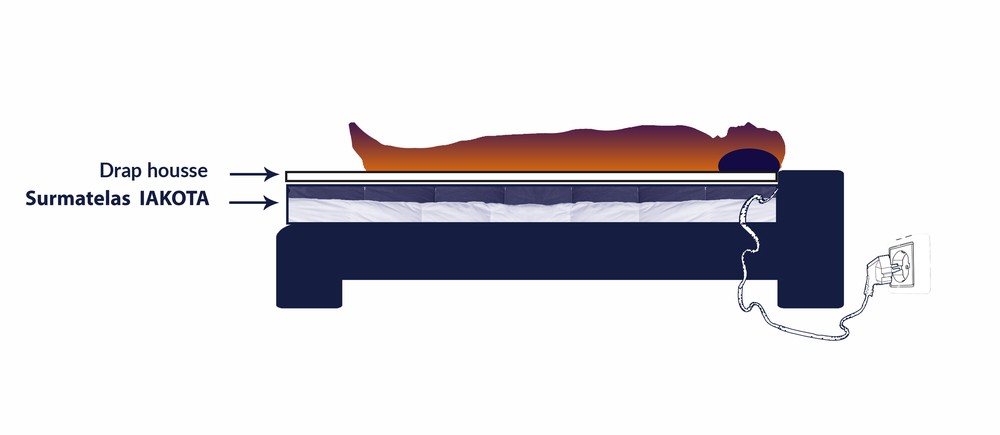
Two things are happening at the same time, and neither of them adds any external energy.
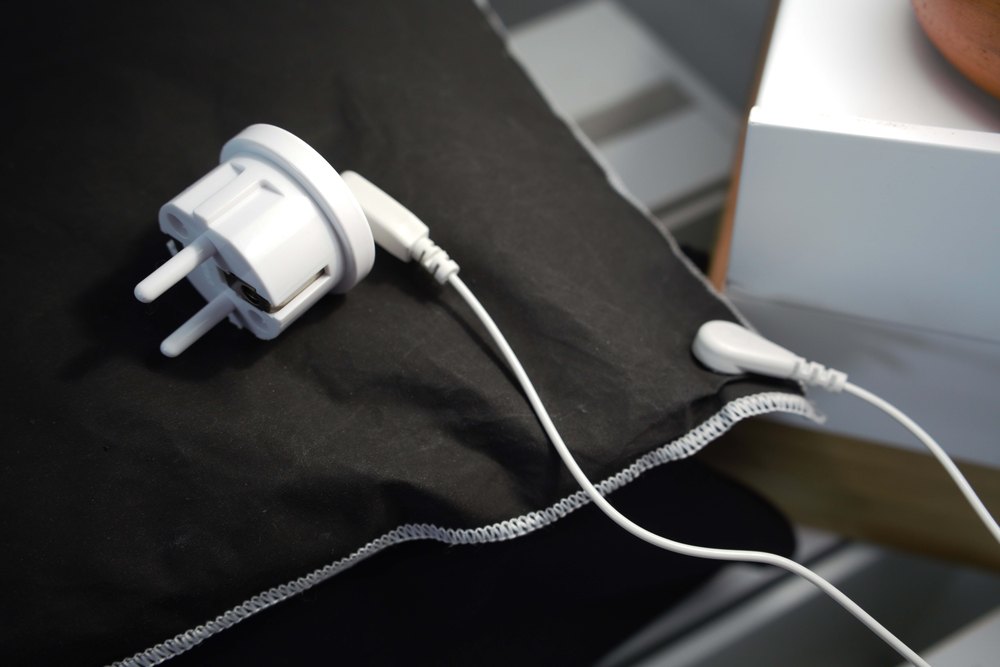
Earthing. The mattress topper connects to the earth pin of a wall socket, just like any other household appliance. The body is brought to the same electrical potential as the floor, and any static charge is discharged. It’s the same principle as walking barefoot on grass, except that it lasts all night. Installation instructions are explained in our guide how does a grounding mattress topper work.
Endogenous infrared. The human body constantly emits radiation in the far infrared range, in the 3 to 20 micrometre band. The active layer of the mattress topper, a formulation of metal oxides, is highly emissive in this same band: it absorbs this radiation and reflects it back towards the body rather than allowing it to escape into the bedding. Nothing is produced, nothing is heated; the radiation is simply reflected. The mechanism is explained in detail on the page Minoxis technology.
A recovery mattress topper is no substitute for sleep, training or diet. It works whilst the athlete is lying down anyway, and that is precisely what makes it feasible: it requires no specific sessions, no discipline, and not even an extra ten minutes of the day.
What the CREPS CNEA study measured
What was measured, and how. In 2024, 27 trail runners took part in a study conducted in collaboration with the CREPS National High-Altitude Training Centre in Font Romeu. Following an intense trail run – six five-minute uphill intervals at 90 % of maximum heart rate – three groups of around nine people were monitored for 48 hours: one sleeping on the mattress topper, one without any support, and one wearing recovery clothing. Two measurements were taken by machine: muscle strength on an isokinetic dynamometer and heart rate upon waking. Two further measurements involved questionnaires completed by hand each morning.
- Muscle strength at 48 hours, average of five tests, as a proportion of the baseline value for each group: 98.6 % for the mattress-topper group, 95.6 % for the group without the device. In other words, the first group had almost regained its original strength, whilst the second was still at four and a half points.
- Resting heart rate at 48 hours, as a deviation from the initial value: -7.7 % for the group using a mattress topper, +6.9 % for the group without a mattress topper. A resting heart rate that rises again two days after exercise is usually a sign of incomplete recovery.
- Spiegel Sleep Questionnaire, recorded every morning: the score for the group using mattress toppers is improving, whilst that of the group without them is falling.
The significance of these figures. The study is internal and has not been published in a peer-reviewed journal. It did not include a placebo group: the participants knew which group they were in, which has little bearing on a force measured by a machine, but more so on hand-completed questionnaires. The sample sizes per group are small, at around nine people. Given these sample sizes, the correct way to put it is that the observed difference favours the mattress topper, not that an effect has been demonstrated. Sleep was assessed only via questionnaires, never by measuring sleep stages.
You can check this for yourself. Nocturnal heart rate variability is the most accessible indicator, and most smartwatches and smart rings already measure it. Record your average over thirty nights before starting, then over thirty nights whilst using the device, whilst keeping all other factors constant. Thirty nights, because a single night is not indicative: HRV fluctuates with alcohol, training load, a late meal or a cold. We explain this indicator on the page What is VFC?. The'National Institute of Sleep and Vigilance features a special report on the role of sleep in athletes’ recovery.
Three sports recovery mattress toppers: prices and uses
All three models have the same active layer and the same grounding system. What differs is their thickness, size and sleeping comfort, and therefore where they are used.
| Model | Price | For whom, for where |
|---|---|---|
| Terra Nomad | €249 to €399 | The foldable, portable design. Training camps, competitions, hotels, guests’ rooms. It’s also the entry-level option for trying out passive recovery at home. |
| Terra Home | £449 to £679 | The mattress topper in the master bedroom: laid out once and left in place. The perfect choice for everyday use all year round. |
| Terra Cocoon | €799 to €899 | Ten centimetres thick, combining sleeping comfort with cutting-edge technology. For anyone who wants to change the feel of their bed, or give a worn-out mattress a new lease of life. |
One final point – which costs nineteen euros and saves you from disappointment – is that the mattress topper only works when earthed if the socket in the bedroom is actually earthed, which is not the case everywhere in older properties. The plug tester, at €19, he says it in a matter of seconds.
How to choose between the three
- First, have a look at where he’s going to sleep. A mattress topper that stays in your bedroom and one that you take with you when travelling are not the same product. If you go away on training camps or to competitions several times a year, the Terra Nomad’s foldable design carries more weight in the decision than its thickness.
- Next, check the condition of your mattress. If it’s comfortable, Terra Home is all you need, and it adds technology without altering the feel in any way. If it starts to sag, the ten centimetres of Terra Cocoon tackle both issues at once.
- Please check the plug type before placing your order. Ensure there is a working earth connection in the bedroom, or install an outdoor earth stake if you sleep on the ground floor.
- Give yourself thirty nights. And record one metric – either your night-time heart rate or resting heart rate – before and after. This is the only way to know whether it works for you, rather than just as an average.
What the mattress topper does not do
We are publishing all the feedback from our satisfaction survey, including the low scores: out of 34 responses, the average is 6.9 out of 10, and three people did not provide a rating. The details can be found on the page review of the mattress topper IAKOTA.
- It does not make up for a lack of sleep. Six hours on a mattress topper are still six hours, and duration remains the key factor, as we explain in detail at How many hours of sleep does an athlete need?, and the INSERM’s sleep dossier sets out the general framework.
- It does not heat up and does not feel like a heat source. The fact that you cannot feel it does not mean it is faulty.
- It does not work under a waterproof mattress protector, as this prevents air circulation. A cotton fitted sheet – and nothing else – should be placed between the body and the mattress topper.
- It does not work the same way for everyone, and some users do not notice any measurable change.
Frequently asked questions
What is the difference between a sports recovery mattress and a mattress topper?
A sports recovery mattress replaces your existing mattress, whilst a mattress topper is placed on top of the one you already have. The difference is practical and it makes a difference: you keep your bedding, you add the active layer on top, and you can take it with you when you travel. The three IAKOTA models are mattress toppers.
Does it need to be plugged into a socket?
Yes, via the earth pin on a wall socket, using the supplied lead. No current flows through the mattress topper: the earth connection acts as an electrical reference point, not a power supply. Without being plugged in, the infrared layer continues to operate, but the earth connection is lost.
How long does it take before one can judge?
You’ll need thirty nights’ data and a measurement taken before and after, either resting heart rate or nocturnal heart rate variability. Over a single night, the measurement noise is greater than the signal we’re trying to detect.
Does it get hot during the night?
No. The active layer reflects the far-infrared radiation that the body already emits, in the 3 to 20 micrometre band, which is not a heating band. There are no heating elements, no power supply and no emission of an active field.
How should it be maintained?
Wash by hand in cold water, rubbing gently. Do not machine wash, do not spin-dry, do not use fabric softener. For everyday use, a cotton fitted sheet is sufficient to protect it.
Which model is best for a sportsman who travels frequently?
Terra Nomad, from €249, which folds up and is easy to carry. Athletes who alternate between training camps, competitions and home often keep the Terra Home at home and the Terra Nomad in their bag.
 Français
 English (UK)
 Español
 Português
 Deutsch