
La earthing during sleep consists of connecting the body to the electrical potential of the earth during the seven or eight hours when it repairs itself. This is the time of day when contact makes the most sense, because that is when the nervous system switches into restoration mode. Here is what research describes, what it does not yet describe, and how to check for yourself if anything is shifting.
What happens in the body when you sleep grounded?
In short
Grounded during sleep, the body balances electrostatic charges accumulated from contact with insulating materials. Available research then describes a lowering of resting heart rate and an increase in heart rate variability, two markers of a parasympathetic dominance, that is to say, a state of recovery.
By day, the body accumulates. Rubber soles, floating floors, synthetic textiles: all these materials are excellent insulators, and that is what is asked of them. The consequence is measured with a voltmeter. A person standing in a modern interior carries a residual voltage of several volts relative to the ground. Connected to the earth, this voltage drops back towards zero.
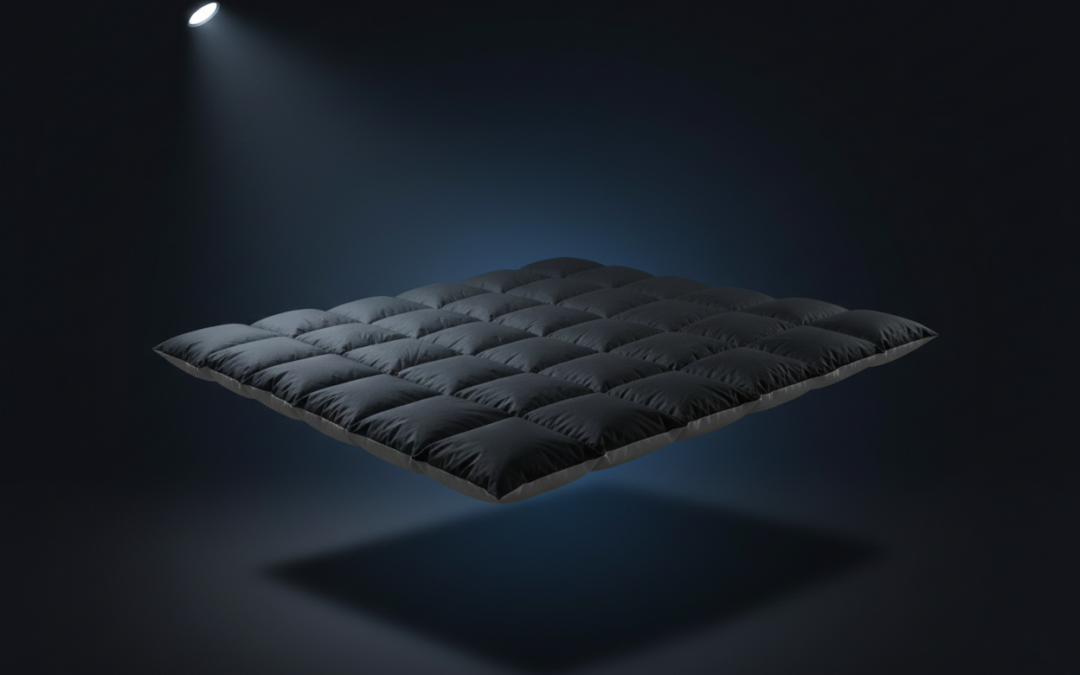
Night is the only time this contact can last without anything interrupting. A earthing mattress topper make the most of this window: seven to eight hours of continuous driver contact, with nothing asked of the user.
At night, a shift towards the parasympathetic system
The autonomic nervous system operates in two complementary modes. The sympathetic mobilises: increased heart rate, alertness, readiness for exertion. The parasympathetic restores: slowed heart rate, digestion, tissue repair. The deep sleep is a state with a strong parasympathic dominance. It is during these phases that muscle reconstruction takes place, and it is for this reason that a short night's sleep is paid for the next day during training.
The hypothesis explored by the literature on grounding is simple: by stabilising the body's electrical potential, this transition would be facilitated. Published data support this, although sample sizes remain modest. It is not a question of falling asleep faster in the sense of a sedative effect, but rather of a night whose structure appears somewhat more favourable to restoration.
Bear in mind
A textile does not replace good sleep hygiene. A cool bedroom, darkness, regular bedtimes: these foundations remain paramount. Earthing works on another level, in the background.
The three nocturnal indicators that move first
If an effect exists, it shows up in measurements, not in how you feel when you wake up. Three indicators are accessible to any smart watch or smart ring on the market.
| Indicator | What he measures | Direction of an improvement | Reading time |
|---|---|---|---|
| Heart rate variability (HRV) | The interval between two heartbeats, a reflection of parasympathetic activity | On the rise | 3 to 4 weeks on average |
| Nocturnal resting heart rate | The lowest heart rate reached during the night | Falling | 2 to 3 weeks |
| Number of night-time awakenings | Sleep continuity | Falling | Often the first sign reported |
HRV is the richest of the three, and the most misunderstood. It should never be read on the basis of a single night: a late dinner or the onset of a cold is enough to make it plummet. Only a multi-week moving average tells a story, which renders any judgement made after three nights worthless.
How do I know if it's really working?
It is the most frequently asked question, and it is a legitimate one. An earthing mattress topper does not heat up, vibrate or make any noise: nothing indicates that it is working. Many disappointed users are so for a much more mundane reason: their socket has no effective earth, and the product never did a thing.
A simple protocol makes it possible to decide in a month.
- Check the socket first. A socket tester costs less than ten euros and gives the answer in two seconds. In buildings dating from before the 1970s, the absence of an effective earth is common. Without an earth, there is always the stake driven into the garden.
- Establish a baseline. Wear your watch or ring for seven nights before installing the mattress topper, and note down the average HRV and the lowest heart rate for each night.
- Install it, then don't touch anything else. Thirty consecutive nights, without changing schedules, bedding or training load. A protocol where three things are altered at once concludes nothing.
- Compare the averages, not the nights. Seven nights before, thirty nights after, on the averages. An increase in HRV accompanied by a drop in resting heart rate is the strongest signal you can get at home.
What the CNEA study shows, and what it does not show
A study conducted at the Font-Romeu National Altitude Training Centre monitored 27 athletes during trail running sessions, with a placebo group. Two findings emerge from this.
CNEA Font-Romeu Study
- Muscle recovery almost total at 48 hours in the hamstrings and quadriceps, whereas it remained incomplete in the control group.
- RMSSD, heart rate variability indicator: a 12 % increase at 48 hours, compared to a 25 % decrease in the placebo group.
Limits to be aware of. Twenty-seven participants is a pilot study sample size, not a large-scale validation one. The population consists of trained endurance athletes, whose recovery mechanisms cannot be directly transposed to sedentary use. This work has not yet been peer-reviewed. A doctoral programme conducted with the CNEA is underway until 2028 to formalise these results.
The honest position is therefore this: the signal is encouraging and consistent with the literature on grounding, but it does not yet have the robustness of established data.
Earthing alone or coupled with infrared
Most grounding sheets sold online perform a single function: to conduct. A silver or carbon thread woven into a textile, a cable, and that's it.
A second family of products adds an independent mechanism, which really comes into its own at night. The human body continuously radiates heat in the form of far-infrared. In a bed, this radiation disperses into the bedding and is lost. A textile designed to absorb it re-emits it towards the tissues, without adding anything: the energy is redistributed, not created.
This is not a heat source, and the distinction is important for thermal comfort at night. In the 3 to 20 micrometre range, infrared does not heat. It stimulates an enzyme, eNOS, whose activation releases nitric oxide, a natural vasodilator involved in microcirculation, and therefore in the supply of oxygen and nutrients to the fibres during the repair phase.
The technology Minoxis, developed by Tortel Innovation in the Rhône-Alpes region, combines the two actions in a single textile. A metal oxide film deposited on a cotton substrate has an emissivity of around 0.95 in the 3 to 20 µm waveband: what it absorbs, it re-emits towards the body, in accordance with Kirchhoff's law. The conductive mesh, meanwhile, ensures earth bonding. The entire assembly remains entirely passive: no power supply, no emitted electromagnetic field.
The four errors that cancel the effect
- The waterproof mattress protector. This is by far the most frequent mistake. A waterproof or coated mattress protector blocks both conduction and infrared reflection. Only a thin cotton fitted sheet should be placed over the top.
- The un earthed socket. A heated mattress topper plugged into a socket with no earth connection does nothing. The socket tester remains the first step, even before unpacking.
- The reverse installation direction. The active side, which is black on IAKOTA models, should be placed facing upwards, as close to the body as possible, with no intermediate layer.
- The snap judgement. User feedback converges on a window of two to four weeks. Concluding after three nights is reading noise.
Frequently asked questions
Should one sleep all night connected to the earth?
This is the intended use, and it is also the simplest. Contact time is the primary parameter: seven to eight hours of sleep offers the longest continuous window of the day. A twenty- to thirty-minute nap provides a shorter contact time, without being useless for all that.
Does grounding help you fall asleep faster?
That is not what the available data describes, and it is not a sedative effect. User feedback more often relates to sleep continuity, with a reduction in night-time awakenings, than to the time taken to fall asleep. As for falling asleep itself, bedroom temperature, light and schedule have a much greater impact.
Can it be used without an earth connection?
For the earthing part, no: an effective earth is essential, failing which all that remains is the stake driven into the ground. On a textile combining both technologies, however, the infrared return continues to work without a connection.
Does this emit waves in the bedroom?
No. The device is entirely passive: it consumes no energy and emits no electromagnetic radiation. It conducts charges to the ground and re-emits radiation back to the body that the body produces itself.
What if my HRV doesn't budge after a month?
First, check the plug socket, the absence of a waterproof mattress protector, and the direction it is laid: these three points account for the majority of cases where it does not work. If everything is correct, the response is individual and there is no guarantee of a measurable result for everyone. This is all the more reason to measure rather than relying on a feeling.
The Terra range
IAKOTA adapt the Minoxis technology into three formats: Terra Nomad, lightweight and foldable for travel and residential courses, Terra Home for everyday use at home, and Terra Cocoon with upper quilting. All are manufactured in the Rhône-Alpes.