
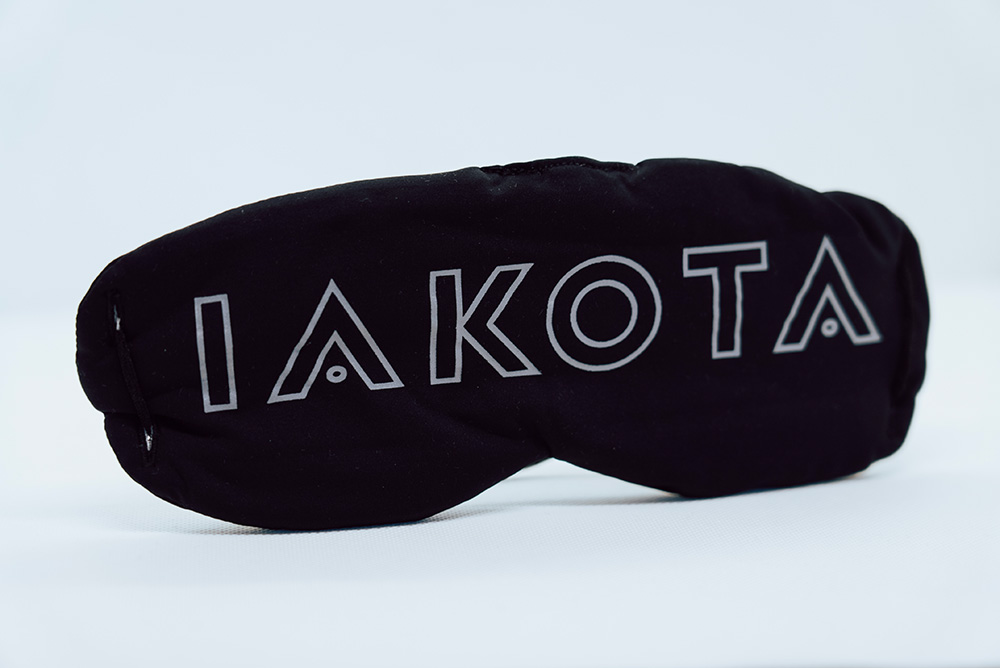
Are you looking for a review of the night mask IOTA's eclipse, perhaps after seeing it on a stand, in a pharmacy or on a marketplace. This article is published by the brand, so it does not serve as an independent review. It brings together what you can base your own on: what can be seen from the first night, what takes weeks, what this mask will not do, and the situations in which it is not suitable.
What is the Eclipse night mask like?
In short
The Eclipse sleep mask is a passive textile: it blocks out light and reflects back towards the face the infrared radiation that the skin already emits. The blocking out of light is noticeable from the very first night. The rest is slow, cannot be felt, and is judged over around thirty consecutive nights.
An ordinary sleep mask fulfils one function: to block out light. This one fulfils two. The first is blackout, immediate and verifiable. The second is the return of endogenous infrared, slow and silent. The two are judged on timescales that have nothing to do with each other, and it is from this confusion that most disappointed reviews arise.
No battery, no diode, no cable, nothing to recharge. The mask consumes no energy and emits none. This difference from heated masks and LED masks is not a nuance of degree: we have detailed it in a dedicated article.
What you notice from the very first night
Three things are judged immediately, and they are the ones upon which a quick opinion has value.
The concealment. An ordinary bedroom is never dark: internet box standby light, street lamp, charging phone, backlit alarm clock. The mask eliminates these residual sources, and maintains the darkness if you open your eyes in the middle of the night. It is judged by a single place, the junction with the face, at the sides of the nose and at the temples. A mask that lets light filter through by the nose loses most of its value, whatever the quality of the fabric.
Pressure on the eyes. The mask is designed with cavities that leave the eyelids free. If you feel any pressure on your eyes, it is generally because the strap is adjusted too tightly, rather than a feature of the product.
The settling-in period. Wearing something on your face all night takes three to five nights of getting used to, and that is the period when people give up.
What you won't feel, and why
The second mechanism cannot be felt: no heat, no vibration, no light, no signal. This is the main source of disappointment with passive products, as nothing comes to confirm that they are working while you sleep.
Yet what is happening is simple to describe. Your body is constantly emitting heat in the form of far-infrared radiation, and the face, which has a rich blood supply, emits a great deal of it. Minoxis fabric carries a metal oxide film that absorbs this infrared radiation and re-emits it towards the skin instead of letting it dissipate into the room. This is the property that physicists call emissivity: a material that absorbs well re-emits well. On this fabric, it is around 0.95 in the 3 to 20 micrometre band. Nothing is created in the process: the energy is redistributed, not added.
This far infrared does not heat. It contributes to local microcirculation via the eNOS enzyme, which releases nitric oxide. The effect is slow and requires prolonged exposure: hence the format, a mask worn for seven or eight hours rather than a device for treatment sessions.
What the study shows, and what it does not say
The mask was the subject of a study conducted by the Vision Sciences Institute. The first point to look at is not the result, but the method: the participants were not asked about how they felt, two parameters were measured.
Vision Sciences Institute Study
- Protocol 20 participants aged 54 to 88, 60 days of night-time use.
- Blink rate : 27.3 to 18.3 per minute (p<0.001).
- Meibomian glands Improvement or maintenance in 83 % of participants (p=0.042).
Twenty people, an advanced age group, sixty days, and a piece of work that is not published in a peer-reviewed journal. This provides a direction, it does not demonstrate, and it says nothing about the result you will obtain.
What these two parameters measure. Blinking is a reflex that spreads and renews the tear film on the surface of the eye. The Meibomian glands, located within the thickness of the eyelid, produce the oily layer of this film, the one that slows down its evaporation between blinks. These are measurements, not statements of satisfaction.
The p-value, in a single sentence. A p-value of less than 0.001 is simply read as: in this group, a difference of this magnitude had virtually no chance of being due to chance. This says nothing about the size of the effect, nor about its generalisability to a younger population than the one in the study.
What users are saying, and the caveats to know
Four user reviews, and where they come from
To date, there is no questionnaire dedicated to the mask. The feedback below comes from a questionnaire sent in May 2025 to purchasers of the mattress topper, where several people spontaneously mentioned the mask used as a complement. The four testimonials that mention it are reproduced here, with the agreement of their authors, including the one who noticed no change.
«The only benefit is during naps with the eye mask where I feel more rested after my daily 20 minutes. But this nap is taken without the mattress.»
«I sleep on it every night, accompanied by the IAKOTA mask, and I also take it with me on all my travels.»
«More restorative sleep (coupled with the night mask, a winning combo), increase in deep sleep and stabilisation of HRV.»
«I've been tracking my sleep and recovery data for a very long time, but I haven't noticed any change since using the mattress topper (and the mask). That said, I don't think the product is ineffective, but unfortunately I can't objectively evaluate any changes.»
Three of these four people use the mask at the same time as the mattress topper, which makes it impossible to attribute to the mask alone what they describe. The first review is the only one that concerns the mask used without anything else, and it is that of a person with mixed feelings about the rest of the range.
The provisos, and the cases where this mask is not suitable
Here are the recurring points, and what they imply before you buy.
| Situation | What you need to know |
|---|---|
| You have never slept with a mask | Allow three to five nights for adjustment. Starting with twenty-minute daytime naps significantly reduces the rate of giving up. |
| You are waiting for a feeling | There will be none, other than darkness. A passive fabric does not heat up and signals nothing. |
| First you look for the lowest price | A simple blackout blind costs significantly less. The price difference is for the second function, not the blackout capability. |
| You have trouble having your face covered | The feeling of confinement cannot be fixed by getting used to it. In this case, the mask is not the right format. |
| You have a known allergy to technical textiles | Check the composition before purchase. The mask combines cotton, a polyurethane membrane and a metal oxide film. |
| You are pregnant or breastfeeding | Seek the advice of a healthcare professional before adding a new product to your nightly routine. |
| You wash everything in the washing machine at 40 degrees | Cold wash, by hand or in a laundry bag, air dry. Aggressive washing damages the active layer and this is irreversible. |
One final caveat: if your nights are persistently bad or if eye discomfort sets in, no wellness product is the answer. That is a matter to take to a healthcare professional.
Form your own opinion in thirty nights
The only data that relates to you is the data you record. It requires consistency rather than equipment.
- Note your starting point for a week. Every morning, a rating from 1 to 10 on the quality of the night and eye comfort upon waking. It's subjective, and that's what you are aiming to improve.
- Add an objective measure if you have one. On a smartwatch, nocturnal heart rate variability and resting heart rate are the most accessible indicators.
- Wear the mask for thirty consecutive nights. That is the minimum duration we recommend, and consistency matters more than the length of each night.
- Do not change anything else. Schedules, caffeine, evening exercise: if three variables change together, no conclusion is possible.
- Compare averages, not days. One bad night doesn't mean anything. Fourteen nights against fourteen nights, yes.
This protocol gives you the means to prove us wrong, as the fourth testimony above did. An individual response is better than an impression.
Frequently asked questions
How to read reviews on an infrared sleep mask?
By separating the two time scales. A review written after two nights is reliable on the blackout, fit and comfort, which are immediate. It says nothing about the infrared return, which requires weeks of use. The most useful reviews are those that specify how many nights the person has been wearing the mask.
Does the Eclipse night mask heat up?
No. Far infrared in the 3 to 20 micrometre band is not heating infrared, and the textile consumes no energy. It must not be confused with heated or LED masks, which are active devices and operate in short sessions.
Does it need to be plugged in, like a mattress topper?
No, the mask works without a cable or plug, solely from the infrared radiation your body already emits. Earthing, on the other hand, requires a physical connection to the electrical ground: that is the principle of a earthing mattress topper, and what is at stake in a night spent grounded. If you compare the two products, compare their installation constraints first.
After how many nights can you make up your mind?
The occlusion is judged on the first night. As for the rest, the study cited above covered 60 days of nocturnal use: we recommend at least thirty consecutive nights before drawing any conclusions.
Is it suitable for a nap at the office or on the go?
Yes, and it is one of the most frequent uses. A twenty to thirty-minute power nap benefits most from complete darkness, which is immediate. On a plane or train, the mask is the only format that works without installing anything.
Is it useful if I spend my days in front of a screen?
This is the scenario where the overnight window matters most, since it is the only long period when the eyes do not work. We explored this in an article about end-of-day eye strain.
The Eclipse night mask
IAKOTA apply Minoxis technology to a blackout fabric, with no energy, no LEDs and no electronic parts: complete darkness and the reflection of the infrared that the face already emits, during the seven or eight hours when you are not asking anything of your eyes. The Eclipse sleep mask is available for €59.