
Infrared mask or LED mask, what's the difference?
The confusion stems from a single word. Both product families use the term «infrared», but they are not talking about the same infrared, and above all they do not work in the same way.
What an LED light therapy mask is
An LED mask is an electronic device. It contains diodes, it recharges, it turns on and off, and it works in short sessions, generally lasting ten to thirty minutes, with your eyes closed beneath the mask.
The wavelengths used are in the visible red spectrum, around 630 to 660 nanometres, and in the near infrared, around 850 nanometres. This is very close to the light that you see. These devices are mostly intended for facial skin care, and are worn during sessions, not overnight.
The prices observed on this market vary widely, ranging from a few tens of euros for entry-level models to several hundred euros for devices sold in perfume shops or salons.
What a passive infrared night mask is
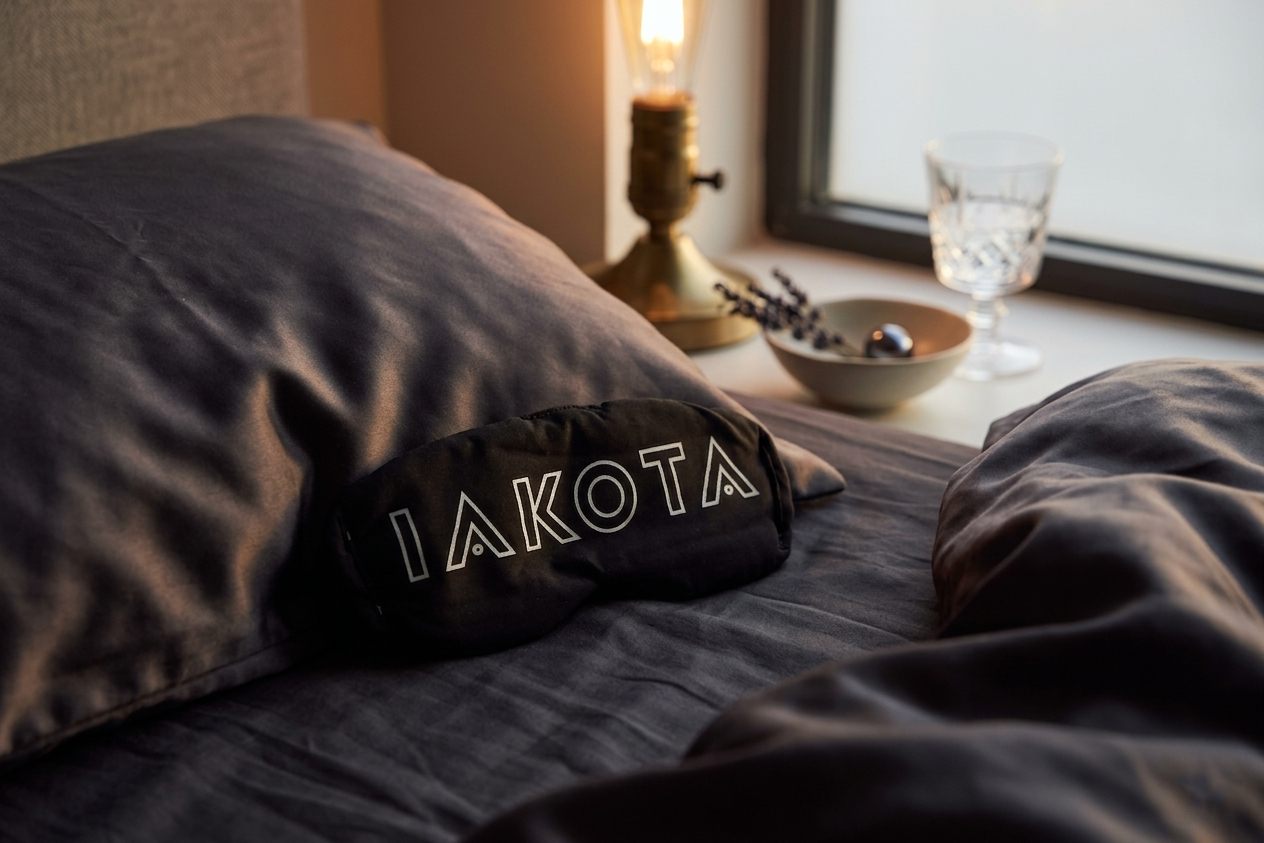
A passive infrared sleep mask has neither a diode, a battery, nor a button. It is a textile. It produces no energy and emits no active electromagnetic radiation.
Its principle is simpler than it seems. Your body is constantly emitting heat in the form of far-infrared radiation. A metallic oxide film deposited on the fabric absorbs this infrared and re-emits it towards the skin, instead of letting it dissipate. This is the property that physicists call emissivity: a material that absorbs well also re-emits well. Nothing is created in the process, the energy is simply redistributed.

Notice the difference in scale compared with LED masks. We are a long way from the 660 or 850 nanometres of red and near-infrared. It is not the same part of the spectrum, and it is not the same mechanism.
This far infrared does not heat. It stimulates the eNOsynthase enzyme, which releases nitric oxide, which plays a role in microcirculation. It is a slow effect, requiring long exposure, which explains why the format is a sleep mask rather than a session device.
An eye mask is used primarily to create darkness. Complete darkness is what allows melatonin secretion to take place without interruption. A mask that lets light in from the sides loses most of its appeal, regardless of the fabric technology.
The table that sums it all up
Which one to choose depending on what you are looking for
The LED mask is made for that. The infrared night mask does not replace it, it doesn't do the same thing.
That is the domain of the night mask. The LED mask is not worn while sleeping, and anyway you would need to add a blackout feature to it.
A passive textile does not recharge, does not light up and emits no active radiation. That is a criterion that matters to many people, and rightly so.
A textile can be folded, slipped into a bag and requires no plug. A device does not.
What the study on the Eclipse mask shows
The Eclipse sleep mask was the subject of a study conducted by the Vision Science Institute: 20 participants aged 54 to 88, monitored over 60 days of night-time use.
What matters here is not that a study exists, it is what it did. The participants were not asked about how they felt. Two parameters were measured.
Blinking is a reflex, and it has a specific function: to remoistise the surface of the eye and spread the tear film over it. Blinking less often therefore means having less need to do so. It is also a measurement and not a statement, since the reflex cannot be decided upon. The p-value of less than 0.001 is simply read as: in this group, a difference of this magnitude had virtually no chance of being due to chance.
These glands, located within the thickness of the eyelid, produce the oily layer of the tear film, the one that slows down its evaporation between blinks. This is the second parameter examined in an ocular comfort assessment.
Twenty people, an advanced age group, sixty days, and work that has not yet been published in a peer-reviewed journal. This points the way, it does not demonstrate, and it says nothing about what you, yourself, will get.
Complete darkness is immediate, right from the first night, and requires no study to be observed. As for the rest, your smartwatch measures your heart rate variability during the night: thirty nights before, thirty nights after. That is the only data that pertains to you.
 Français
  English (UK)
  Español
  Português
  Deutsch